Sharehood is a neighbourhood app for people who would rather borrow a drill, a kitchen appliance or camping gear than buy one. A map shows what is sitting unused nearby, a radius request goes out when nothing turns up, and pickup and return get sorted directly in chat. I built the app alone, from concept to running it, published through my company BLUNATECH.
Why a neighbourhood app for borrowing
The drill that gets used once a year. The air fryer that has been unwrapped twice since it was bought. The tent and sleeping mats sitting in the basement, needed only for one week of summer holiday. Buying things like that costs money and eats up storage space, especially in a flat. At the same time, almost every neighbourhood already has all of this lying around unused somewhere, you just do not know at whose place.
That is the gap Sharehood fills: an app for borrowing and lending within your own neighbourhood, map-based and hyperlocal. It is built for people who want to spend less and live a bit more sustainably, for whom “share instead of buy” is not a slogan but an everyday problem.
The difference from existing apps: Kleinanzeigen and Vinted are about buying and selling, shipping rather than proximity. Nebenan.de is a general neighbourhood network where borrowing is, at best, a minor feature among many. Sharehood does one thing and does it properly: find something you only need for a short while, and lend out what you are not using yourself, no marketplace noise, no shipping.
How Sharehood works
The flow is deliberately reduced to three steps.
| Step | What happens |
|---|---|
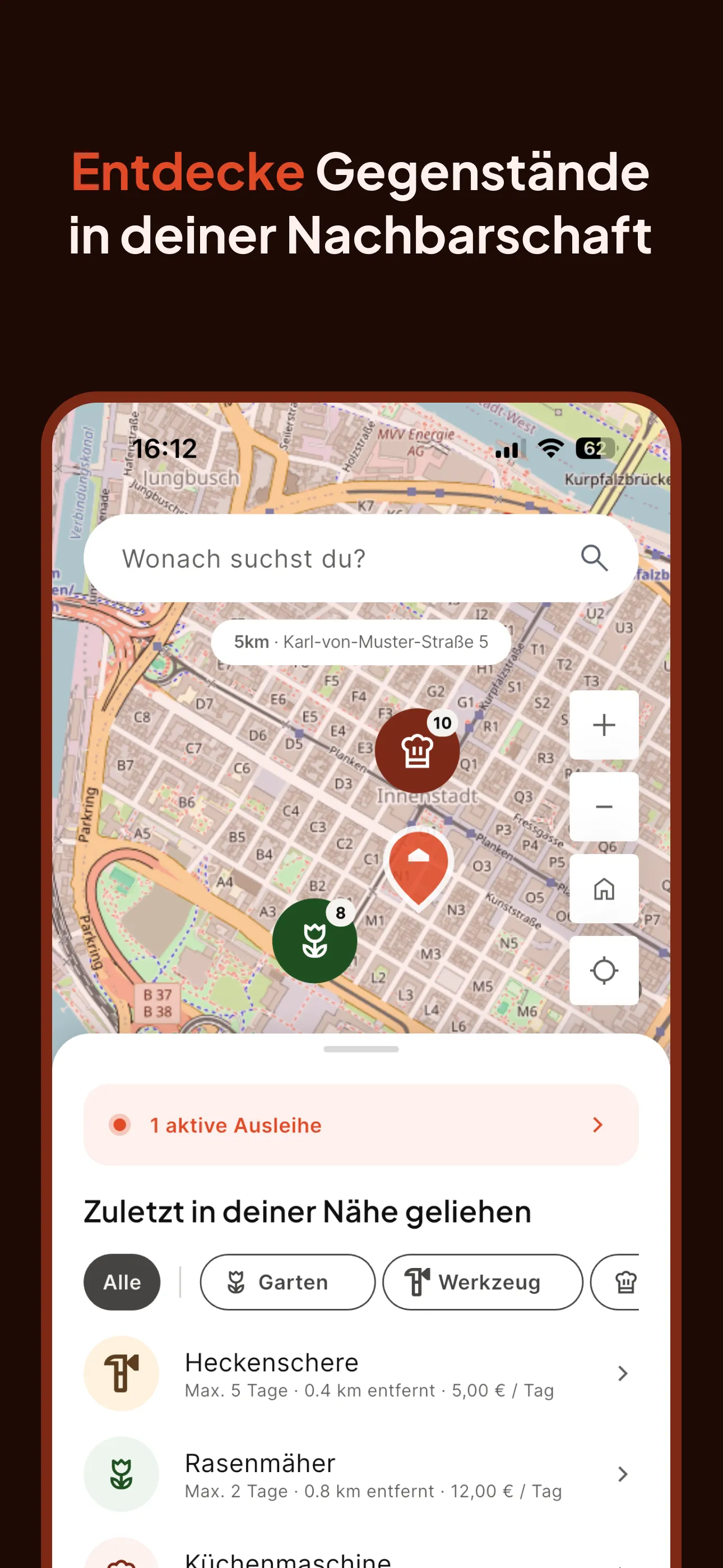
| Discover | A map shows items nearby, grouped by category, with distance and price per day |
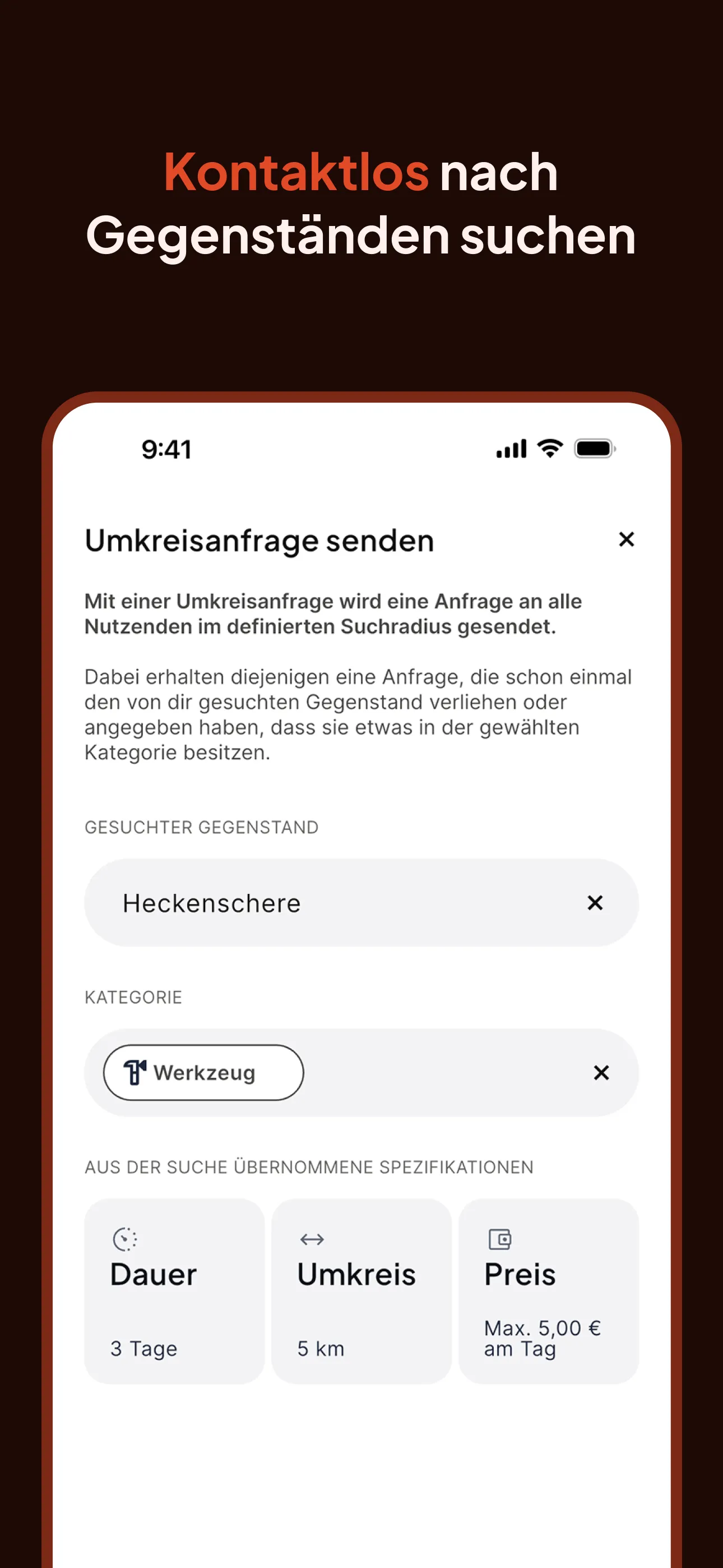
| Radius request | Nothing found? A request goes straight to everyone in the chosen radius who has previously lent or listed something in the matching category |
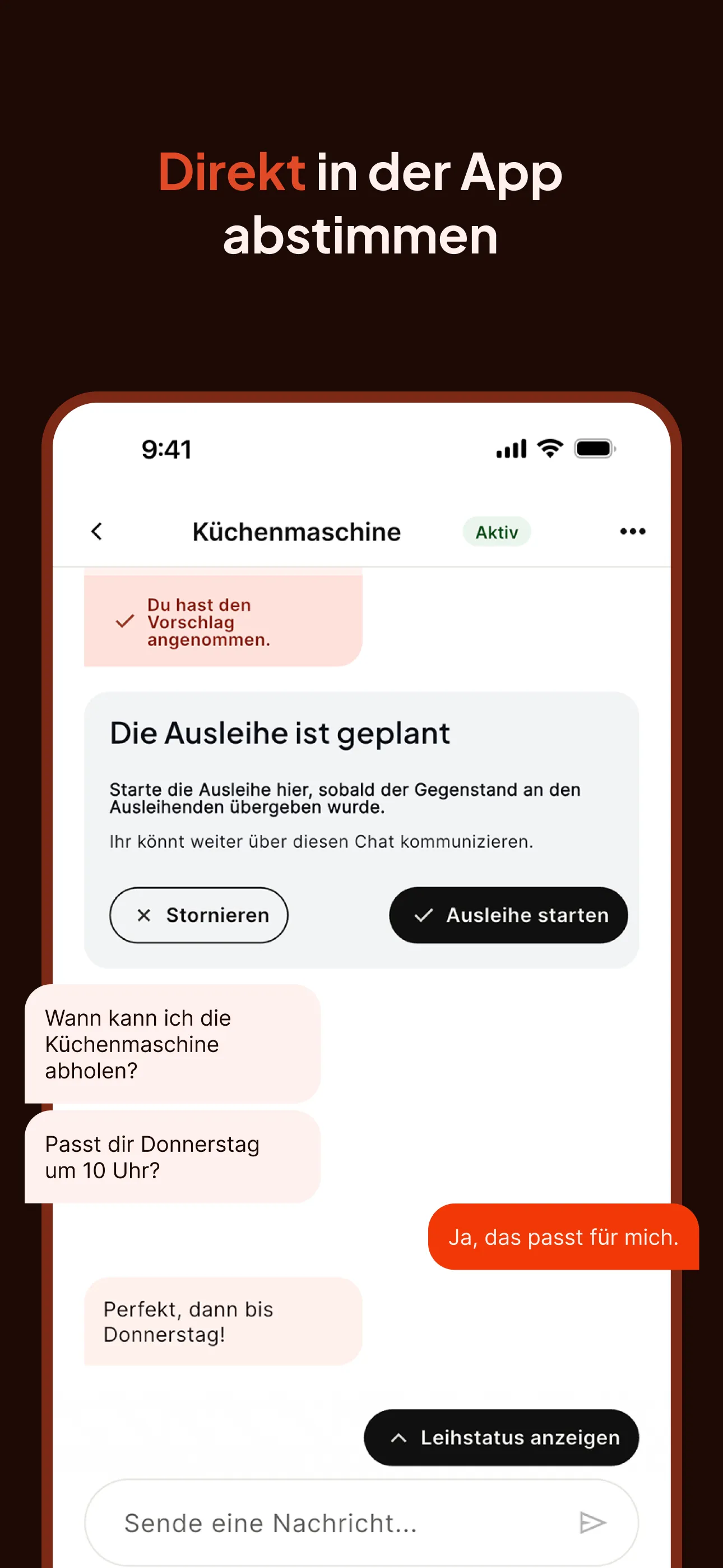
| Chat and loan | Sort out the handover in chat, start the loan with one tap once the item has actually changed hands, and keep an eye on the return date |
A loan does not begin the moment a request is accepted, only once both sides confirm in chat that the item has actually been handed over. The return date follows from the agreed loan duration, but it can be extended or the loan ended early whenever needed.
-
Discover
5 km around you
-
Radius request
Hedge trimmer
3 days 5 km max. 5 € a day
Send request -
Chat and loan
When can I pick it up?
Thursday at 10?
✓Loan started
Features that carry the everyday use
- Map with categories: tools, garden, kitchen and more, with icons and live location, items you are currently lending out are grayed out automatically.
- Radius requests: instead of scrolling the map for ages, a targeted request to the neighbourhood with category, radius, loan duration and maximum price.
- Chat with loan status: accept a proposal, agree on the handover, start the loan, extend it or end it early, all in the same conversation.
- Your own inventory: manage what you lend out, with photos, category and availability.
- Report and block: built into the chat, backed by a documented, human moderation process.
- Push reminders: for new requests and messages, on both iOS and Android.
Architecture and stack
Sharehood is a solo project: concept, Figma design, development, store releases and day-to-day operations are all mine. The publisher in the app stores is my company, BLUNATECH GmbH.
The app
The app is built with Flutter, one codebase for iOS and Android. The architecture is a strict four-layer stack, app -> business -> component -> foundation, and every feature module inside business follows an MVVM pattern with a view, a view model, a repository and a model. From day one, every module got a repository interface plus a mock implementation, well before a real backend existed. State is managed with provider and ChangeNotifier, the map runs on flutter_map with OpenStreetMap tiles, and the device location comes from geolocator.
Backend
Supabase runs in the background: Postgres with the PostGIS extension for real radius search, distance to the user’s own location is calculated server-side through a PostGIS function rather than estimated on the device. Row level security keeps every user’s data separated, and edge functions handle account deletion and chat push. Push notifications go out on Android through Firebase Cloud Messaging, and on iOS through the native APNs bridge.
Web and operations
The landing page at sharehoodapp.de is a standalone Astro app inside the same repository as the Flutter app, deployed on Vercel. I manage the FAQ and testimonials through my own Supabase-backed admin page, while the site itself stays fully static. I automate releases for both stores with fastlane.
What I learned building it
Mock-first pays off when the backend arrives. Every feature module got a repository interface and a mock implementation from the start, long before Supabase was connected. When the real backend was ready, only new implementations of those interfaces had to be added, views and view models did not need to change at all.
An automatic security advisor is not always right. Supabase flagged PostGIS’s own spatial_ref_sys table as a critical finding: row level security disabled, publicly readable and writable. It looked like a genuine vulnerability. Root cause analysis showed something else: the default fix of simply enabling RLS would have broken ST_Transform, because this project’s PostGIS installation is not relocatable and would then lose track of its coordinate reference systems. The right fix was a minimal read-only policy, not the advisor’s default suggestion.
A chat with user content needs a person behind it. Apple requires apps with direct messaging between users to have not just a report and block feature, but a moderation process that responds within 24 hours. The in-app features alone are not enough, so there is a documented, manual process for the reports that land in the database.
Try Sharehood
Sharehood has been available in the German App Store as “Sharehood: Leihen & Teilen” since August 2026, and on Google Play since August 27, 2026, completely free with no ads and no in-app purchases. The pilot is currently running in the Mannheim area, with more cities planned.
Get the app for iPhone or Android, more information at sharehoodapp.de (German only). Questions or feedback on the app? Write to me at kontakt@bitzer-fabian.de.